
Open Positions
Thank you for your interest in the Gaab Lab!
The Gaab Lab works at the intersection of neuroscience, education, EdTech, and policy. We focus on typical/atypical learning trajectories with a special focus on language and reading development and the role of the environment in shaping these trajectories.
Dr. Gaab will be accepting 1-2 new PhD students in the 2026 application cycle with interests in a variety of topics related to neuroscience, education, learning disabilities, and/or learning trajectories. For more information about the Ph.D. program at the Harvard Graduate School of Education, please see here: https://www.gse.harvard.edu/degrees/phd
** Unfortunately, we cannot host or directly supervise middle or high school students in our lab. We receive hundreds of similar requests each year, and the time and administrative demands of our ongoing projects mean we cannot take on additional mentoring or interview commitments, even virtually. **
Not Recruiting:
Research Assistant
This Research Assistant will be responsible for:
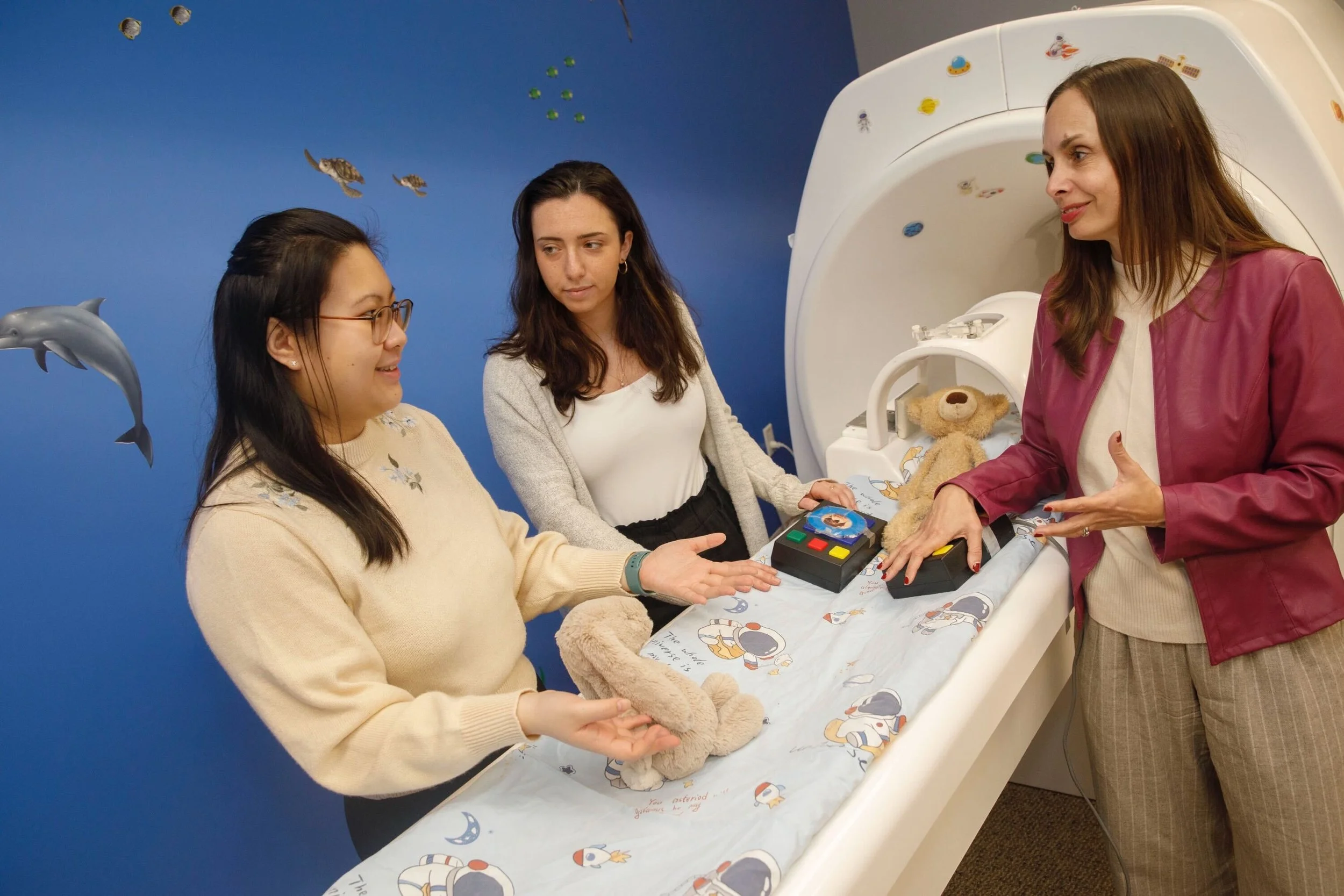
MRI/fMRI scanning and behavioral testing of young children and adolescents
Subject recruitment for research studies, which may include close interaction with schools and healthcare centers in the Boston area
Scheduling of research participants and their parents
Implementation and maintenance of analysis software
Preparation of IRB documentation and submissions in conjunction with the Principal Investigator and/or other members of the research team
Conducting data collection activities and preparing analytical reports regarding results of studies
May have an opportunity to contribute to stimuli design, data analyses and/or publications
Summer Intern
As a summer intern, you will gain experience in data entry and analysis, participant recruitment, and data collection. Data collection can include observing or helping with behavioral testing. The summer internship takes place in-person at our lab in Cambridge and is a full-time position, approximately 35hours/week Monday-Friday. Availability to work over the weekend occasionally is a plus. The internship will take place from early/mid June - early/mid August (~10 weeks). The ideal candidate will be detail-oriented, careful, self-motivated, and interested in our lab's work, and have a background in neuroscience, psychology, linguistics, education, computer science, or a related field. Currently, this is an unpaid position, but the candidate must earn course credits or acquire external funding. Both undergraduate and graduate students are encouraged to apply.
Other helpful points, you would learn more about:
• MRI/fMRI data analysis and behavioral testing of young children and infants
• Subject recruitment for research studies, which may include close interaction with schools and daycare centers in the Boston area
• Scheduling of research participants and their parents
• Use of analysis software
Semester Intern
As an intern, you will gain experience in data entry and analysis, participant recruitment, and data collection. Data collection can include observing or helping with behavioral testing. We are looking for someone who can dedicate at least 8 hours a week to the lab. Availability to work over the weekend occasionally is a plus. The ideal candidate will be detail-oriented, careful, self-motivated, and interested in our lab's work, and have a background in neuroscience, psychology, linguistics, education, computer science, or a related field. Currently, this is an unpaid position, but the student may be eligible to earn course credits. To apply, you must be a Harvard University undergraduate or graduate student.
Other helpful points, you would learn more about:
• MRI/fMRI data analysis and behavioral testing of young children and infants
• Subject recruitment for research studies, which may include close interaction with schools and daycare centers in the Boston area
• Scheduling of research participants and their parents
• Use of analysis software
To apply, please send your CV and cover letter to gaablab@gse.harvard.edu. Thank you!
Psychoeducational Evaluator
The Psychoeducational Evaluators will be responsible for:
Administering several psychometric assessments pertaining to cognitive, language, reading and math development, including (but not limited to) the Comprehensive Test of Phonological Processing, the Woodcock Johnson Tests of Oral Language and Cognitive Abilities, the Clinical Evaluation of Language Fundamentals, the Woodcock Reading Mastery Test, and the Gray Oral Reading Test.
Conducting in-person sessions of 3 hours in length with research participants in elementary, middle, and early high school, as well as the scoring of these assessments.
Travel to the lab at the Harvard Graduate School of Education (50 Church St., Cambridge MA) will be required.
NOTE: This position is strictly for behavioral testing; psychoeducational evaluators will not be trained on neuroimaging data collection or analysis.
To qualify, you must have: Experience administering psychoeducational assessments and experience working with kindergarteners and/or school-age children. A basic understanding of psychometrics, good organizational skills, and careful attention to detail are desired. The candidates will work approximately 3-14 hours per week (varies based on scheduling). Hourly pay ranges from $20 to $30 depending on experience. Start date is ASAP. To apply, please send a CV and cover letter to gaablab@gse.harvard.edu.